
Accessibility is a signal path 7 min read
Assistive Listening: Delivering the Right Sound to Every Listener
Compare delivery technologies and design an assistive-listening feed that includes the complete program.
- Explain why direct audio can improve access.
- Compare loop, RF, infrared, and network delivery.
- Design a complete assistive-listening mix.
- Include receivers, signage, support, and testing in the handoff.
Why an AV engineer should care
A room can meet its general loudness target while remaining difficult for a listener with hearing loss. Distance, reverberation, and background noise reduce the clarity of speech. An assistive-listening system delivers a more direct program feed to a listener's receiver or compatible hearing device.
This is an end-to-end service. A transmitter in the rack does not establish that a visitor can find, use, and hear the system.
Start with the program feed
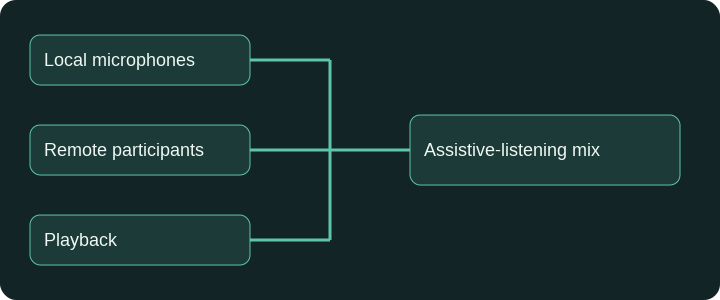
The feed must contain what the listener needs: presenter microphones, audience questions, remote participants, and playback. Room loudspeakers may not reproduce every source at the same balance because some sources are already audible acoustically. A listener using a direct feed may need those sources included explicitly.
Derive the mix from a deliberate bus. Identify where its level, equalization, dynamics, and mute controls live. Avoid inadvertently applying loudspeaker-specific correction or delay to a feed that has a different purpose. Maintain suitable headroom through the transmitter input and receiver output.
A silent audience-question microphone is still a problem even when the presenter feed sounds excellent. Test the full event sequence.
Delivery technologies
An induction loop creates a magnetic field that compatible telecoils can receive. It can offer direct access for users with suitable hearing aids or implants. The loop design must address field strength, uniformity, frequency response, metal losses, interference, and spill into adjacent spaces. A wire around the room is not automatically a commissioned loop.
RF systems send audio to compatible receivers by radio. Coverage can extend beyond walls, which helps mobility but requires coordination and consideration of adjacent rooms. Infrared systems use light and can provide useful room containment, but coverage depends on emitter placement, obstruction, and optical conditions.
Wi-Fi audio sends the program over a network to an application or receiver. Its success depends on the network, user onboarding, supported devices, delay, and available receivers. Asking every visitor to bring a charged phone, install an app, and locate the right network is an operational assumption that needs explicit review.
Bluetooth broadcast systems, including Auracast implementations, can provide another delivery path. Compatibility is specific to the receiving device and implementation; the word Bluetooth alone does not establish support. Evaluate the complete visitor experience and required loan equipment.
Compatibility and access requirements
In US projects, applicable accessibility requirements must be checked against the project and jurisdiction. The ADA Standards address assistive-listening scoping in Section 219 and technical provisions in Section 706. Receiver quantities and hearing-aid-compatible provisions are part of that review. Selecting a modern transport does not by itself demonstrate compliance.
Record the applicable design basis and have the project's responsible accessibility/code professional confirm it. Keep the specification concrete: spaces served, coverage, receiver provision, hearing-device compatibility, signage, and operating responsibilities.
Delay and the listener's experience
A listener may hear both the room's acoustic sound and the direct electronic feed. Excessive relative delay can produce an echo or an uncomfortable sense of separation. Test actual receiver configurations in the seating area, including any phone or accessory required by the chosen system.
The loudspeaker alignment delay is not automatically the correct assistive-listening delay. Different paths may have different processing and transport times. Listen and measure the complete result rather than adding delay because another output has it.
Two commercial examples
Council chamber: The assisted-listening feed includes members, public comments, remote callers, and media playback. A separate bus provides an intelligible balance independent of room-volume changes. Staff can demonstrate a receiver, and signage directs visitors to the equipment without requiring them to interrupt a meeting.
Divisible training center: Each room needs an identifiable program, with a clear combined-room state. Test leakage or unintended channel selection between adjacent spaces. Label receivers and channels consistently, and verify that joining rooms does not leave users listening to an inactive feed.
Handoff is part of the design
Specify storage, charging, cleaning, loan procedure, consumables, and who checks equipment before an event. Include compatible listening accessories and instructions for users with hearing devices. A locked receiver drawer with no assigned staff member is an access failure.
During commissioning, walk the coverage area, check every required source, verify receiver operation and battery runtime expectations, and document any limitations. Train staff with the actual receiver rather than only showing the transmitter's web page.
Practical exercise
Draw the assistive-listening path for a meeting room. Trace one local microphone, one remote participant, and one playback source into the feed. Then trace how a first-time visitor obtains a receiver and hears the correct program. Mark every missing technical or operational step.
Compact glossary
- ALS: Assistive-listening system.
- Telecoil: A coil in a compatible hearing device that receives a magnetic audio signal.
- IR: Infrared.
- RF: Radio frequency.
- Neckloop: An accessory that couples receiver audio to a compatible telecoil.
Review questions
- Why might the room's main mix be incomplete for assistive listening?
- Does a new wireless technology automatically satisfy access requirements?
- What must be tested beyond the transmitter?
Answers
- It may omit sources that are acoustically audible in the room.
- No; evaluate the applicable requirements and complete implementation.
- Coverage, all program sources, receivers, accessories, delay, and the visitor support process.
Where this fits
Every listening destination now has a purpose. Next: proving the finished audio system and turning it over with useful evidence.