
Follow every destination 7 min read
Live Console Signal Flow: Channels, Buses, DCAs, and Matrices
Build a console file around destinations and understand which controls change audio and which control other controls.
- Trace an input through processing and routing.
- Distinguish an auxiliary mix, subgroup, DCA, and matrix.
- Choose pre- or post-fader sends intentionally.
- Keep recording and monitoring paths independent where needed.
Why an AV engineer should care
A console is a routing system with a mixing surface attached. When a presenter disappears from a stream but remains audible in the room, the right question is which path stopped carrying that signal. Knowing the block flow makes that question answerable.
Start a show file by listing destinations: audience, stage monitors, overflow, recording, livestream, assistive listening, and communication. Each destination needs a deliberate mix and control strategy.
The input channel
A physical or network input is patched to a channel. An analog microphone path usually includes a preamplifier before conversion; a digital source arrives with its conversion already completed. Digital trim is not necessarily the same thing as controlling the remote analog preamp.
The channel can then include polarity, high-pass filtering, equalization, dynamics, delay, and a fader. The exact order and available tap points vary by console. A block diagram tells you whether a send is before or after a particular processor.
A channel name should describe the source, and the patch should identify the actual connector or network channel. Naming something Podium does not guarantee that it receives the podium input. Label both.
Buses carry mixes
A bus combines selected signals. The main left/right bus is one familiar example. An auxiliary bus lets each input contribute at its own send level, which is useful for stage monitors or an independent stream mix.
A subgroup typically collects channels so their summed audio can be processed or controlled together before reaching another destination. A vocal subgroup can carry group compression. Avoid unintentionally sending the same input both directly to the main bus and through an additional subgroup path; that can change level and introduce timing interactions.
A matrix commonly builds an output mix from buses, although some consoles also allow direct channel contributions. It can feed lobby, delay speakers, recording, or other zones with independent level and processing. Check the platform's actual routing options instead of assuming every matrix works the same way.
A DCA does not carry summed audio
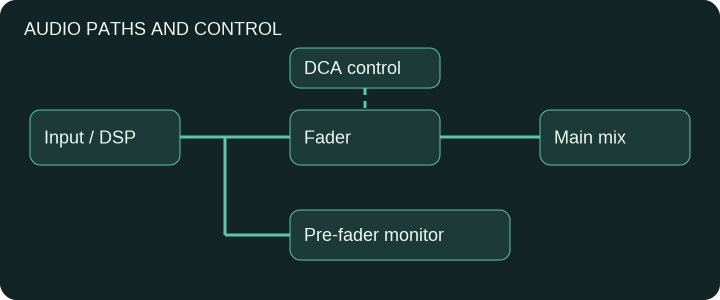
A digitally controlled amplifier group, usually called a DCA, changes the effective level of assigned channels. It is a control relationship. There is no summed audio signal inside the DCA on which to insert a compressor. Use an audio subgroup for that job.
A DCA can make all presenter microphones easier to ride together while maintaining individual fader relationships. Its influence on pre-fader sends, mute behavior, and other paths depends on console implementation and configuration. Test those behaviors before relying on them during a show.
Pre-fader and post-fader sends
A pre-fader send is taken before the channel fader, so the channel fader generally does not change that send's level. It is often useful for monitors: lowering a singer in the audience mix need not lower the singer's own monitor.
A post-fader send follows the channel fader. This is commonly useful for effects, so the amount of reverberation tracks the source level. An output mix may also intentionally follow the main mix.
Pre-fader does not mean independent of everything. The send may still follow input gain, channel processing, a mute, or a DCA mute. The precise tap point matters. If two engineers share one stagebox preamp, a gain adjustment can affect both even when their console faders are independent.
Two commercial examples
Corporate panel event: Four microphones feed the room, stream, and assisted-listening system. The room mix may require less playback than the stream because attendees hear some sound directly. Build a separate stream bus when that balance must differ. Preserve a suitable feed for assistive listening rather than deriving it accidentally from a loudspeaker zone with aggressive correction.
School performance: Vocal microphones feed main speakers and two stage-monitor mixes. Pre-fader monitor sends keep front-of-house rides from continually changing what performers hear. A vocal DCA provides convenient audience control; a subgroup provides shared vocal processing. Those are different jobs, even when they contain the same channels.
Organize the file for another operator
Group related inputs, use consistent colors, and label outputs by destination. Put the sources needed during a speech on an accessible layer. Keep system alignment processing in a clearly identified place so a show operator does not mistake loudspeaker delay for a creative effect.
Record each output's source bus, physical patch, nominal level, processing owner, and mute behavior. A saved file is useful, but a one-page signal-flow drawing is much faster to inspect when someone asks why the lobby is silent.
Practical exercise
Create a rehearsal file with one microphone, a main bus, a pre-fader auxiliary, and a post-fader auxiliary. With outputs safely monitored, move the channel fader, mute the channel, and move an assigned DCA. Write down which meters change. Compare the observed behavior with the console block diagram. Do not assume a pre-fader label predicts every mute action.
Compact glossary
- Bus: A path combining selected audio signals.
- Auxiliary: A mix with independent contributions from input channels.
- Subgroup: A summed group of audio channels.
- DCA: A control group for channel levels.
- Matrix: An output mixing stage, often fed by other buses.
- Tap point: The location from which a signal is taken.
Review questions
- Can a compressor be inserted into a DCA's summed audio?
- Why use a pre-fader monitor send?
- Does pre-fader mean unaffected by input gain?
Answers
- No; a DCA does not carry a summed audio path.
- To separate monitor balance from channel-fader changes in the main mix.
- No; upstream gain can still affect it.
Where this fits
The console file now has an intentional structure. Next: preserving that structure through show files, scenes, recall scope, and virtual soundcheck.