
Choose the coverage 7 min read
Loudspeaker Architectures: Point Sources, Ceiling Systems, Columns, and Line Arrays
Match loudspeaker geometry and directivity to the audience, room, and listening task.
- Compare point sources, distributed systems, columns, and arrays.
- Estimate ceiling-speaker coverage at the listening plane.
- Separate a nominal coverage angle from a complete prediction.
- Choose an architecture before trying to equalize the room.
Why an AV engineer should care
A loudspeaker can sound excellent on its own and still be the wrong choice for a room. The first design question is where its sound needs to go. Equalization cannot move a coverage pattern away from a glass wall, and adding amplifier power does not bring a listener into that pattern.
The useful progression is audience geometry, acoustic conditions, required level and bandwidth, then loudspeaker architecture. A product family comes after that. This connects the earlier processing lessons to the physical system they serve.
Coverage is a three-dimensional problem
Directivity describes how radiation varies with direction. A nominal 90° horizontal by 60° vertical pattern gives a starting point, usually tied to a stated level reduction and frequency range. It is not a hard-edged cone: sound continues outside it, and the pattern changes with frequency. Low frequencies commonly spread more widely than high frequencies.
Examine horizontal and vertical data, mounting orientation, and useful coverage across the speech range. An enclosure rotated on its side may rotate an asymmetric pattern too. Some horns can be rotated independently; verify the exact model.
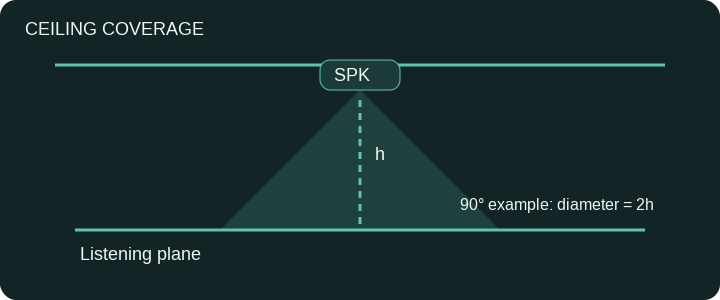
Coverage should be evaluated at listeners' ears. For a downward-facing ceiling speaker, the relevant height is the difference between the speaker and the listening plane, not the distance to the floor.
Point sources and distributed ceilings
A conventional point-source system concentrates sound at one or several locations. In an ideal free field, a point source loses approximately 6 dB each time distance doubles. Actual rooms add reflections and boundaries, so that rule is a useful direct-sound estimate rather than a complete room prediction.
A front loudspeaker can give a convincing connection between a presenter and the sound. The challenge is reaching the back without overwhelming the front. Correct aiming, a suitable pattern, and sometimes delayed fills help.
Distributed ceiling speakers reduce the difference in distance between nearby and distant listeners. They are useful for conferencing, paging, and background music. Their advantage is consistent local coverage; they do not automatically provide strong stage localization or concert-level output.
For a preliminary circular footprint, diameter equals twice the height above the listening plane multiplied by the tangent of half the coverage angle. With a 6-foot height difference, a 90° pattern gives about a 12-foot diameter. That is a geometric sketch, not a finished spacing standard. Frequency response, overlap, ceiling obstructions, required uniformity, and manufacturer prediction still matter.
Columns and line arrays
A column uses multiple drivers arranged vertically. That arrangement can narrow vertical coverage while retaining a relatively wide horizontal pattern. Steering-capable columns use processing to direct the beam, which can help keep sound off reflective ceilings. Beam control depends on array length, driver spacing, frequency, and design. A slim enclosure is not proof of useful low-frequency control.
A line array combines elements whose geometry, spacing, waveguides, and processing are designed to work together. A finite array behaves differently at different distances and frequencies. The often-quoted 3 dB loss per distance doubling describes an idealized line-source region, not an unlimited promise for every seat. Prediction software and the manufacturer's deployment rules matter.
More boxes also bring rigging, weight, aiming, power, and service implications. Hanging hardware is part of an engineered assembly. Acoustic suitability does not establish structural suitability.
Two commercial examples
Reverberant council chamber: A wide ceiling pattern sends substantial energy into hard surfaces. A properly selected column aimed at seated listeners may improve the balance of direct to reflected speech. Evaluate the rear seats and balcony separately; narrow vertical coverage can miss them.
Divisible training room: Distributed ceiling loudspeakers may provide even conferencing playback in each room state. Separate zones, room-combine routing, and level control are as important as the ceiling layout. A full-room prediction alone will not reveal a poor divided-room experience.
What belongs in the design package
Record the listening plane, required level and headroom, coverage target, mounting location and orientation, and the room states evaluated. Include prediction settings and the actual loudspeaker model. A drawing that shows only speaker circles leaves critical assumptions to the installer.
Check overlap areas as well as the centers of coverage. Two coherent arrivals can interfere, producing frequency-dependent peaks and dips. Filling a blank spot by adding another loudspeaker may improve level coverage while introducing timing problems. Document why each fill exists and how it will be aligned.
Practical exercise
Sketch a room with an 11-foot ceiling and a 5-foot standing listening plane. Estimate footprint diameters for 75°, 90°, and 140° nominal coverage: approximately 9.2, 12, and 33 feet. Then mark walls and adjacent loudspeakers. Which pattern puts the most energy outside the intended area? Do not turn these numbers directly into installation spacing.
Compact glossary
- Directivity: Variation in radiation with direction.
- Listening plane: Height used to represent listeners' ears.
- Point source: An approximation for a source small relative to the relevant distance and wavelength.
- Fill: A supplementary loudspeaker serving an inadequately covered area.
- Beam steering: Using array processing to change radiation direction.
Review questions
- Does a nominal coverage angle stay constant at every frequency?
- Which height belongs in a ceiling-speaker footprint estimate?
- Does every line array lose only 3 dB per distance doubling?
Answers
- No; inspect frequency-dependent data.
- Height above the intended listening plane.
- No; finite arrays have frequency- and distance-dependent behavior.
Where this fits
We have moved from processing individual signals to choosing the physical loudspeaker system. Next: subwoofers, room modes, and directional bass.