
Mix-minus routing 10 min read
Mix-Minus: Send Everyone Except Yourself
Build conferencing sends, multi-codec mixes and voice-lift routes that exclude each destination’s own return.
- Distinguish far-end receive from near-end transmit.
- Build a basic conferencing mix-minus.
- Create separate mixes for multiple codecs.
- Understand how mix-minus interacts with AEC references.
- Apply zone-based mix-minus to local speech reinforcement.
Why an AV engineer should care
Most conferencing feedback and echo problems can be reduced to one routing mistake:
A destination receives audio that originally came from that same destination.
A remote participant speaks. Their voice enters the DSP, plays in the room and then gets routed electronically straight back to them. AEC may remove the acoustic copy picked up by the microphones, but it cannot rescue careless routing that directly returns the codec’s own receive signal.
Mix-minus solves this by creating a separate mix for each destination:
Give the destination everything it needs, minus its own return.
This principle applies to USB conferencing, VoIP, multiple codecs, divisible rooms, recording feeds and local voice lift.
1. Start with the point of view
A USB conferencing interface usually provides two audio directions:
| Direction | Meaning |
|---|---|
| USB receive/input to DSP | Audio coming from the computer and far-end participants |
| USB transmit/output from DSP | Audio being sent from the room to the computer |
Unfortunately, manufacturers name these from different perspectives. A block called USB Input may mean audio entering the DSP from the computer. Someone else might call the same signal USB Playback, Far-End Receive or Speakerphone In.
For system drawings and DSP files, use functional names:
FAR_END_RX_TEAMSNEAR_END_TX_TEAMSBUS_LOCAL_MIC_AUTOMIXREF_ROOM_A_AEC
The arrows should make the direction unmistakable. “USB 1” is how innocent technicians lose an afternoon.
2. The basic conference-room mix-minus
A simple room contains:
- Local microphones
- A room DSP
- A USB-connected Teams or Zoom computer
- Room loudspeakers
The routing is:
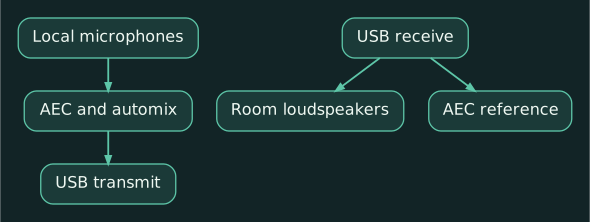
The critical missing connection is:
USB receive → USB transmit
That crosspoint must remain off.
The far end should receive:
- Local microphone automix
- Local presentation audio, if intentionally shared
- Other approved local sources
It should not receive:
- Its own far-end return
- The room loudspeaker mix
- The AEC reference bus
- An already mixed signal containing its return
Shure’s current P300 guidance shows the same basic topology: automix feeds the USB output, while USB input feeds the loudspeaker output and provides the AEC reference. (shure.com)
3. Mix-minus and AEC solve different loops
These two functions work together, but they solve different problems.
Mix-minus prevents an electronic loop
The DSP does not directly route the far-end receive signal back to its source.
AEC removes an acoustic return
Far-end audio plays through the loudspeakers, travels through the room, enters the microphones and would otherwise be transmitted back.
So:
- Mix-minus fixes the matrix.
- AEC fixes the room’s acoustic echo path.
You need both in a normal installed conferencing system.
Q-SYS recommends that all far-end and program sources reproduced in the room feed the AEC reference, while no microphone should feed its own reference. (help.qsys.com)
A correct basic topology is therefore:
| Source | Room speakers | AEC reference | USB transmit |
|---|---|---|---|
| Local microphone automix | Usually no | No | Yes |
| USB far-end receive | Yes | Yes | No |
| Local program source | Yes | Yes | Optional |
| Paging or emergency audio | As designed | If played during calls | Usually no |
Local microphones may feed loudspeakers when the system provides voice lift. That requires additional mix-minus and AEC-reference planning, covered in the voice-lift sections below.
4. Why muting the loudspeakers does not fix routing
Suppose the far end hears itself.
Someone mutes the room loudspeakers and the echo continues. That tells you the return is probably electronic rather than acoustic.
Check the routing matrix for:
- USB receive routed to USB transmit
- A room bus containing USB receive routed to USB transmit
- Recording or streaming buses fed back into conferencing
- A second codec returning the first codec’s audio incorrectly
- Software loopback or operating-system monitoring
- Duplicate DSP and application routing
If muting the loudspeakers stops the echo, investigate:
- Missing or incorrect AEC reference
- Duplicate AEC
- Poor AEC convergence
- Excessive loudspeaker level
- Incorrect USB device mode
- Microphones bypassing AEC
That simple mute test helps divide the problem into electronic routing or acoustic cancellation.
5. One codec is easy; two require separate mixes
Imagine a room connected simultaneously to Teams and a telephone hybrid.
Sources:
LOCAL_MICSTEAMS_RXPHONE_RX
Destinations:
ROOM_SPKTEAMS_TXPHONE_TXAEC_REF
A valid routing matrix might be:
| Source | Room speakers | Teams transmit | Phone transmit | AEC reference |
|---|---|---|---|---|
| Local microphones | No* | Yes | Yes | No* |
| Teams receive | Yes | No | Yes | Yes |
| Phone receive | Yes | Yes | No | Yes |
| Program audio | Yes | Optional | Optional | Yes |
*Assuming there is no local voice lift.
Notice the diagonal exclusions:
- Teams does not receive
TEAMS_RX. - The telephone does not receive
PHONE_RX.
If the goal is to bridge the two remote parties, Teams receives the telephone return and the telephone receives the Teams return. Local microphones go to both.
This arrangement is sometimes called N-minus-one: each destination receives the complete conference mix minus itself.
Do not build one universal CONFERENCE_SEND bus and feed it to every codec. Each codec needs a destination-specific mix.
6. Practical example: MXA920, Q-SYS and Teams
Assume:
- Shure MXA920
- Q-SYS Core
- Teams Room computer through USB
- HDMI program source
- Ceiling loudspeakers
The paths should be:
Near-end microphone send
MXA processed automix → near-end send mixer → USB transmit
Far-end receive
USB receive → room-source mixer → speaker processing
AEC reference
USB receive + HDMI program → AEC reference
Optional presentation send
HDMI program audio → USB transmit
Whether HDMI audio should be sent to Teams depends on the room workflow. If the presentation is already shared digitally through Teams, sending its analog audio again may create duplication, delay or an echo-like effect.
The commissioning file should identify:
- Which device owns AEC
- Which device owns automixing
- USB transmit and receive directions
- Every source included in the near-end send
- Every source included in the AEC reference
- USB speakerphone mode
Shure and Biamp USB devices can advertise whether the host should use its own AEC or treat the installed system as an echo-cancelling speakerphone. Actual host behavior still depends on the operating system and conferencing application. (shure.com, tesira-help.biamp.com)
7. Practical example: divisible airwall rooms
Consider the familiar arrangement:
- Room A has its own codec.
- Room B has its own codec.
- Each room has microphones and loudspeakers.
- Two additional microphones cover the airwall area.
Separate mode
Room A:
- A microphones → Codec A transmit
- Codec A receive → A loudspeakers and A AEC reference
- Codec A receive excluded from Codec A transmit
Room B follows the equivalent independent path.
No audio crosses between rooms.
Combined mode with one primary codec
The cleanest approach is often to select one codec as the combined-room conferencing endpoint:
- All six microphones → combined automix → selected codec transmit
- Selected codec receive → all combined-room loudspeakers
- Selected codec receive → all active microphone AEC references
- Secondary codec muted or disconnected from the combined routing
Combined mode with both codecs active
If both calls must be bridged:
- Local microphones feed both codecs.
- Codec A receive feeds Codec B transmit, but not Codec A transmit.
- Codec B receive feeds Codec A transmit, but not Codec B transmit.
- Both receives feed the room loudspeakers and appropriate AEC references.
That is valid, but operationally more complex. The touchpanel needs to tell the user whether calls are independent, selected or bridged. Invisible conferencing logic is how meetings become séance sessions.
8. Mix-minus for local voice lift
Mix-minus also improves local speech reinforcement.
Suppose a large boardroom has eight microphone positions and four loudspeaker zones. Sending every microphone equally to every speaker creates short acoustic loops and poor gain before feedback.
Instead:
- A microphone is attenuated or excluded from the nearest loudspeaker zone.
- It is reinforced more strongly in distant zones.
- Participants hear talkers from across the room without blasting their own voice back at them.
Biamp’s mix-minus conference-room example uses this approach for 16 gooseneck microphones and eight ceiling-speaker zones. The company recommends performing potential-versus-needed-acoustic-gain calculations before relying on the topology. (support.biamp.com)
A simplified matrix might look like:
| Microphone | Near speakers | Middle speakers | Far speakers |
|---|---|---|---|
| Front mic | Off | –6 dB | 0 dB |
| Middle mic | –6 dB | Off | –6 dB |
| Rear mic | 0 dB | –6 dB | Off |
Those values are illustrative. Actual levels depend on distance, loudspeaker coverage, room acoustics and required gain.
9. AEC references with voice lift
Voice lift creates a more advanced problem: one microphone’s locally reinforced audio may enter other microphones.
A microphone must never receive itself in its own AEC reference. However, in some reinforced systems, each microphone’s AEC reference may include:
- Far-end receive
- Program audio played locally
- Other microphones reproduced near that microphone
- Its own microphone excluded
That requires a unique reference mix for each AEC channel. Biamp calls this per-channel AEC referencing and documents it as an AEC mix-minus arrangement. (support.biamp.com)
This is where copy-and-paste DSP architecture becomes dangerous. Each reference must correspond to what that particular microphone actually hears from the loudspeakers.
Practical troubleshooting exercise
Draw a matrix with these sources:
- Local automix
- USB receive
- HDMI program
- Telephone receive
And these destinations:
- Room speakers
- USB transmit
- Telephone transmit
- Recording
- AEC reference
Then apply these rules:
- USB transmit excludes USB receive.
- Telephone transmit excludes telephone receive.
- Each remote codec may receive the other codec if bridging is required.
- The recording feed receives local microphones and both remote returns.
- The AEC reference receives every electronic source played through the room speakers.
- Local microphones do not enter their own AEC reference.
Finally, mute the room loudspeakers during a test call. If a remote participant still hears themselves, inspect electronic routing before touching the AEC settings.
Compact glossary
- Mix-minus: Destination-specific mix excluding that destination’s return.
- Far-end receive/RX: Audio arriving from remote participants.
- Near-end transmit/TX: Local audio sent to remote participants.
- N-minus-one: Full conference mix minus one destination’s own signal.
- Matrix mixer: Router that independently controls each input-to-output crosspoint.
- Voice lift: Local speech reinforcement intended to improve coverage.
- AEC reference: Electronic copy of audio expected to emerge from room loudspeakers.
- Codec: Hardware or software endpoint encoding and decoding conference media.
- Electronic loop: Signal returned through routing without passing acoustically through the room.
- Acoustic loop: Signal reproduced by loudspeakers and recaptured by microphones.
Review questions
- Why must USB receive normally be excluded from USB transmit?
- What belongs in a basic room’s AEC reference?
- When bridging two codecs, what does each codec receive?
Answers
-
USB receive originated at the far end. Sending it directly back would make remote participants hear themselves.
-
Far-end and program sources that are reproduced through the room loudspeakers, at levels that track what the room actually hears.
-
Each codec receives the local microphone mix and, if bridging is intended, the other codec’s return. It excludes its own return.