
Echo cancellation 10 min read
Acoustic Echo Cancellation
Build correct AEC references, understand adaptive echo processing and commission conferencing audio methodically.
- Distinguish acoustic echo from feedback.
- Explain reference signals and adaptive echo-path models.
- Interpret ERL, ERLE, double-talk and nonlinear processing.
- Select one appropriate location for AEC processing.
- Commission and troubleshoot an AEC system methodically.
Why an AV engineer should care
Without acoustic echo cancellation, a remote participant’s voice follows this path:
- Arrives from the far end.
- Plays through the local loudspeakers.
- Re-enters the local microphones.
- Gets transmitted back to the far end.
- Reaches the original talker after a noticeable delay.
That person hears their own voice coming back. Even a small delay makes conversation miserable because the human brain apparently objects to being heckled by itself.
AEC solves this by learning the acoustic path between the room loudspeakers and microphones, predicting the returning loudspeaker signal and removing it from the outgoing microphone audio.
1. Where acoustic echo comes from
Consider a remote participant speaking into a call:
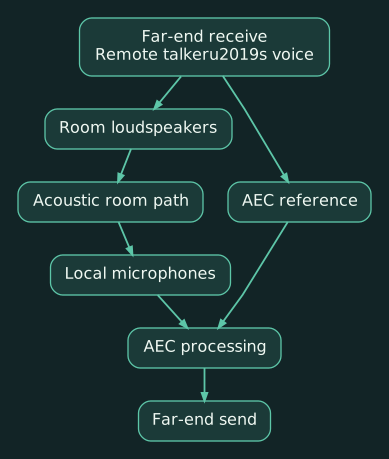
The local microphone receives:
- Local speech
- The remote participant’s voice from the loudspeakers
- Room reflections
- Background noise
The DSP cannot simply mute the microphone whenever the remote participant speaks because that would prevent natural two-way conversation. Instead, the AEC receives a clean copy of the remote participant’s signal through its reference input.
The AEC compares that reference with what appears at the microphone and builds a mathematical model of:
- Loudspeaker response
- Loudspeaker-to-microphone distance
- Room reflections
- Output level
- Acoustic delay
This model is called an adaptive filter because it changes as the echo path changes.
The predicted echo is subtracted from the microphone signal, ideally leaving local speech while removing the far-end voice.
2. The reference tells the AEC what to remove
The AEC reference should contain the electronic sources capable of playing from the room loudspeakers.
In a typical conference room, that includes:
- USB or codec far-end receive
- HDMI program audio
- Audio from remote presentation participants
- Other electronic playback routed to the speakers
The reference usually excludes:
- Local microphones
- The AEC output
- Signals not reproduced in the room
- Local voice-lift channels, unless the manufacturer’s design specifically requires them
Q-SYS advises that everything routed to the loudspeakers should also reach the AEC reference in a non-voice-lift conference system. It also warns against routing a microphone into its own reference. (help.qsys.com)
Where to tap the reference
The reference normally branches after controls that change what the room hears:
- Source selection
- Program mute
- Far-end volume
- User playback level
It commonly branches before loudspeaker-specific processing such as:
- Speaker voicing EQ
- Crossover filters
- Zone delay
- Protection limiting
This lets the reference follow the content and level sent to the room while leaving speaker-specific correction in the output path.
The exact tap varies by DSP platform. Follow the manufacturer’s documented topology rather than treating this as a universal fixed rule.
3. One AEC channel per microphone signal
Microphones in the same acoustic environment may share one reference, but each independent microphone channel generally needs its own AEC processing channel.
Why? Each microphone has a different echo path:
- Different distance from each loudspeaker
- Different reflection pattern
- Different level
- Different frequency response
- Different acoustic obstructions
A four-channel AEC component commonly has:
- Four microphone inputs
- Four processed outputs
- One shared reference input
Biamp Tesira similarly separates its AEC structure into input, processing and reference components. (support.biamp.com)
If a ceiling microphone supplies only an internally processed automix output, the device may perform AEC on that combined signal internally. That is a manufacturer-specific architecture and should remain intact.
4. Adaptation and convergence
When the system starts, the AEC must learn the acoustic echo path. This process is called convergence.
It needs far-end reference audio to learn. Silence provides nothing useful.
Once converged, the adaptive filter continues adjusting for changes such as:
- Loudspeaker volume
- People entering or leaving
- Doors opening
- Furniture moving
- A divisible wall opening
- Microphone or loudspeaker movement
- Source-routing changes
Small changes are normally handled continuously. Major changes may temporarily reduce echo-cancellation performance while the filter reconverges.
Do not commission AEC using a whisper-quiet far-end signal and then assume it will behave identically when the client cranks the call volume to “airport terminal.”
5. ERL and ERLE
ERL: Echo Return Loss
Echo Return Loss describes how much weaker the loudspeaker echo is when it reaches the microphone compared with the reference signal.
Better physical acoustics generally improve ERL:
- Loudspeakers farther from microphones
- Lower loudspeaker level
- Directional microphone placement
- Acoustic treatment
- Reduced reflective surfaces
- Appropriate loudspeaker aiming
AEC works more easily when the room provides natural acoustic separation.
ERLE: Echo Return Loss Enhancement
ERLE describes how much additional echo reduction the AEC creates electronically.
Shure’s AEC meters display ERLE as the amount of echo reduction being applied, with activity generally following the reference when the reference is correctly routed. (shure.com, shure.com)
ERLE should be evaluated while:
- Far-end audio is active
- The near end is quiet
- The system has had time to converge
It is a diagnostic measurement, not a score to maximize blindly. The real acceptance question is whether the far end hears objectionable echo during realistic conversation.
6. Double-talk
Double-talk means the near-end and far-end participants are speaking simultaneously.
The AEC must distinguish:
- Far-end echo returning through the microphone
- New local speech that must be preserved
During double-talk, the algorithm may slow or temporarily freeze adaptation so it does not mistakenly learn that local speech is part of the echo path.
Poor double-talk performance sounds like:
- One participant repeatedly cutting out
- Robotic or watery speech
- Aggressive level pumping
- Half-duplex operation
- The system choosing a winner every time two people speak
A proper commissioning test must include both sides talking at once. Testing only one direction at a time proves that two monologues work. It does not prove that a conversation works.
7. Residual echo and nonlinear processing
The adaptive filter may not remove every trace of echo. Rooms contain nonlinear behavior, noise and changing reflections.
Many AEC systems therefore include nonlinear processing, or NLP, to suppress residual echo after adaptive cancellation.
More aggressive NLP can remove stubborn echo, but excessive settings may cause:
- Chopped syllables
- Metallic speech
- Reduced double-talk quality
- Audible gating
- Unnatural room ambience
Shure recommends using the lowest NLP setting that works effectively in the room; its current products may also provide an adaptive automatic setting. (shure.com)
Treat high NLP as a tool for difficult rooms, not the opening move in commissioning.
8. AEC is not feedback suppression
Echo is a delayed copy of far-end audio returning to the original talker.
Feedback is a local regenerative loop:
microphone → DSP → amplifier → loudspeaker → microphone
AEC is designed primarily to prevent conferencing echo. It does not replace proper gain-before-feedback design for local reinforcement.
If the room rings or howls locally:
- Reduce the reinforcement gain
- Improve microphone and loudspeaker placement
- Aim microphone nulls
- Apply appropriate EQ
- Use mix-minus or zone-based voice lift
- Reduce the number of open microphones
Turning AEC knobs while a lectern mic feeds back into nearby ceiling speakers is yelling at the wrong block.
9. Avoid duplicate AEC
AEC may exist in:
- A ceiling microphone
- A DSP
- A USB bridge
- A conferencing appliance
- Teams, Zoom or another software platform
Cascading multiple independent echo cancellers can make speech sound processed, unstable or gated. Shure specifically recommends disabling downstream AEC when the microphone is already providing it, and vice versa. (shure.com)
For each system, document:
- Which device owns AEC
- Which signal enters it
- Which signal provides the reference
- Which other AEC functions are disabled
- Whether the conference platform knows it is receiving echo-cancelled audio
The last item varies by platform and USB implementation.
10. Practical example: MXA ceiling microphone with Q-SYS
Suppose an MXA920 feeds a Q-SYS Core and the Core connects to a Teams room through USB.
Two valid architectures may exist.
AEC in the MXA
- Route USB receive and applicable program audio to the MXA AEC-reference input.
- Use the MXA’s processed automix output.
- Disable Q-SYS AEC on that microphone path.
- Continue routing, mix-minus and output processing in Q-SYS.
AEC in Q-SYS
- Send the intended raw or preprocessed microphone channels to Q-SYS.
- Disable microphone AEC for those channels.
- Provide the Core’s AEC component with the room playback reference.
- Process and automix the post-AEC channels.
Pick one architecture, document it and test it. “AEC everywhere for extra cancellation” is not how extra cancellation works.
11. Practical example: divisible rooms
In separate mode:
- Room A microphones use Room A’s loudspeaker reference.
- Room B microphones use Room B’s reference.
- Airwall microphones remain inactive.
- Each room converges on its own acoustic environment.
In combined mode:
- All active microphone AEC channels receive the reference representing the combined loudspeaker playback.
- Airwall microphones become active.
- Source routing changes before the reference is unmuted.
- The wall opening changes the acoustic path, so the AEC must adapt.
Test the actual mode transition. A correct diagram does not prove that references switch in the right order or that the filters recover gracefully.
Practical commissioning sequence
- Confirm microphone and loudspeaker placement.
- Establish proper input and output gain structure.
- Disable duplicate AEC processing.
- Route far-end and program sources to the correct reference.
- Verify reference-meter activity.
- Play far-end speech while the local room remains quiet.
- Listen from the far end for returning echo.
- Confirm ERL and ERLE behavior.
- Test local speech alone.
- Test sustained double-talk.
- Change far-end volume and source selection.
- Test room-combine modes and partition transitions.
- Save meter screenshots and final AEC settings.
Compact glossary
- AEC: Acoustic echo cancellation.
- Reference: Clean copy of audio expected from the room loudspeakers.
- Adaptive filter: Changing model of the acoustic echo path.
- Convergence: Process of learning the echo path.
- ERL: Acoustic reduction before electronic cancellation.
- ERLE: Echo reduction produced by the AEC.
- NLP: Nonlinear processing for residual echo.
- Double-talk: Near and far participants speaking simultaneously.
- Echo path: Loudspeaker-to-room-to-microphone route.
- Tail length: Time span of reflections an AEC can model.
Review questions
- Why must far-end volume controls normally affect the AEC reference?
- What does poor double-talk performance sound like?
- Why should AEC generally operate in only one device per microphone path?
Answers
-
The reference must track the signal level actually sent to the loudspeakers so the adaptive filter can predict the returning echo accurately.
-
Participants cut each other off, speech becomes gated or robotic, or only one side can speak intelligibly at a time.
-
Cascaded independent cancellers can process each other’s output and cause gating, artifacts and unstable adaptation.